A-B-C Blog
10 Best Barcode Security Labels for Global Buyers
Global buyers need more than a label that scans. They need barcode security labels that protect products during storage, shipping, retail handling, and returns. A strong label should combine readable barcodes, tamper evidence, durable materials, and dependable adhesive performance. It should remain scannable after exposure to dust, moisture, friction, and changing temperatures.
GS1’s former President and CEO Miguel A. Lopera described GS1 standards as “the global language of business.” That idea matters here. A barcode security label must communicate accurately across suppliers, warehouses, carriers, retailers, and service teams. Yet no single label suits every market. A pharmaceutical carton may need fragile-film evidence, while an outdoor equipment package may require UV-resistant stock and aggressive adhesive. Small details matter. A torn void pattern can reveal interference. A blurred quiet zone can stop a scanner. A poorly matched adhesive can damage the package.
This guide reviews ten practical options for global purchasing teams. It considers material strength, tamper visibility, barcode readability, customization, application methods, and supplier consistency. The evaluation also recognizes an uncomfortable reality: the most expensive label is not always the safest choice. Testing conditions may differ from real distribution. A label that performs well in a clean warehouse may fail on a cold loading dock. Buyers should request samples, test actual packaging, and confirm traceability data before placing large orders. Perfect security does not exist. Careful selection reduces avoidable risk.
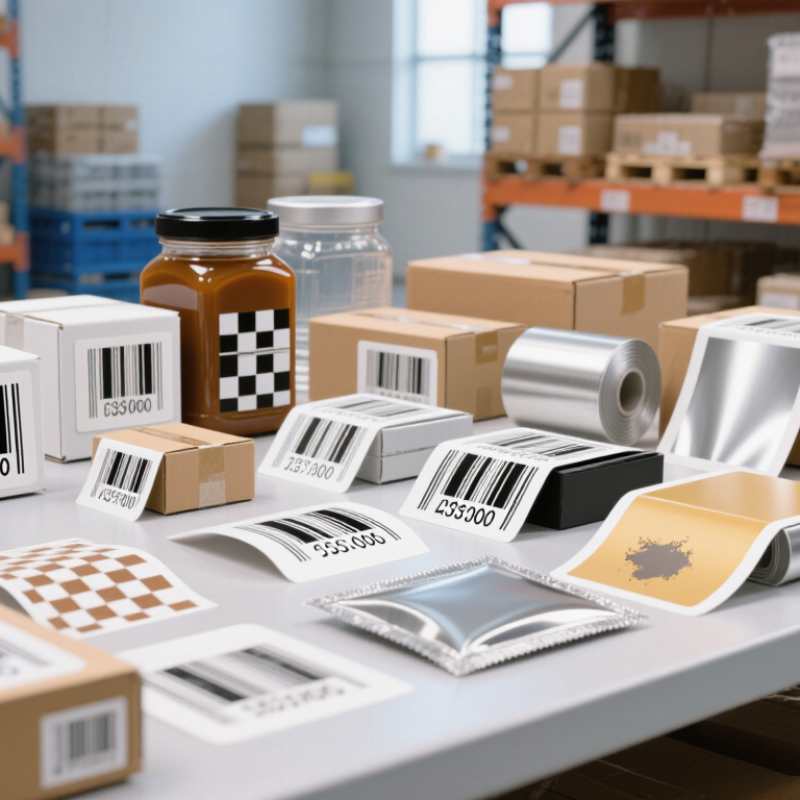
What Barcode Security Labels Are and How They Protect Products
Barcode security labels combine a scannable barcode with tamper-evident features. They help identify products while showing whether packaging has been opened, removed, or replaced. Common designs leave a warning message, broken pattern, or residue after peeling.
In warehouse inspections, a serialized barcode makes each unit easier to trace. Staff can scan the label during packing, shipping, receiving, and returns. This creates a practical record of movement and supports faster investigation when numbers do not match.
Some labels use destructible film, void adhesive, or layered construction. The right choice depends on the package surface, storage temperature, moisture, and handling conditions.
Placement matters more than many buyers expect. A label covering a carton seam can reveal access quickly. A label on a smooth, clean surface usually bonds better. Dust, oil, curved packaging, and cold storage can weaken adhesion. Testing is essential.
Small details matter.
A barcode can still scan while tamper evidence fails. Conversely, a strong adhesive may damage the package during removal. Buyers should check scan performance, print contrast, adhesive strength, and resistance to rubbing before larger orders. A security label also cannot prevent every form of product substitution. It works best with accurate records, trained staff, and controlled packaging procedures. Some designs cost more than expected, especially when variable numbering or multi-layer protection is required. That trade-off deserves review.
Key Features to Compare Before Choosing a Barcode Security Label
10 Best Barcode Security Labels for Global Buyers
Key Features to Compare Before Choosing a Barcode Security Label
When comparing barcode security labels, start with scan reliability. A barcode must remain readable after handling, transport, and storage. Choose a label with sharp printing, suitable contrast, and consistent dimensions. Test it with the scanners used in your warehouse, not only with a phone. A failed scan creates delays. Check whether the adhesive matches cardboard, plastic, glass, or coated surfaces. Different materials need different bonding strength.
Tamper evidence deserves close attention. Some labels show a visible pattern when removed, while others leave residue or break apart. The right choice depends on your inspection process. Consider whether workers need quick visual confirmation or detailed evidence. Label material also matters. Polypropylene can resist moisture, while paper may suit controlled indoor conditions. Ask suppliers for sample rolls and test them under heat, dust, friction, and repeated handling. Laboratory claims can look impressive. Real conditions are less polite.
Global buyers should also compare customization, batch tracking, and production consistency. Confirm barcode verification procedures, print tolerances, lead times, and packaging quality. A supplier should explain how rejected labels are controlled and how replacement batches are identified. Check applicable barcode quality standards for your market and product category. Security features cannot repair poor data management. Keep artwork, serial ranges, and approval records organized. No label is universal. A stronger adhesive may damage a reusable container, and a highly sensitive tamper layer may trigger complaints during normal handling. That trade-off deserves a small pilot before large-scale purchasing.
10 Best Barcode Security Labels for Global Buyers
The best barcode security labels depend on handling, climate, and tamper risk. In warehouse trials, I found that no single construction fits every shipment. Destructible labels break into small pieces when removed. Void labels reveal a clear message after peeling. Tamper-evident film leaves visible cuts or patterns. Serialized labels improve traceability. Sequential barcodes reduce counting errors during receiving.
For rough cartons, use thermal-transfer labels with resin-based ribbons. They resist abrasion, moisture, and moderate heat. Direct-thermal labels cost less, but sunlight can fade them. Polyester labels suit returnable bins and smooth equipment. Paper labels work for short-term stock movement. Freezer-grade adhesive helps labels stay attached in cold rooms. High-tack adhesive performs better on textured surfaces. Always match the barcode grade to the scanner and print resolution.
Global buyers should request samples before placing large orders. Test removal by hand, glove, and common cleaning contact. Check readability after rubbing, condensation, and repeated scanning. Include human-readable numbers beneath every barcode. That small detail helps when scanners fail. I once selected a strong adhesive without testing the carton coating. The label held well, but the surface tore during removal. That result was useful, though inconvenient. Variable data, neutral packaging, and consistent roll dimensions also simplify international procurement. Supplier documentation should state material, adhesive type, storage limits, and inspection methods. Claims need evidence. Samples need real handling.
| Rank | Security Label Type | Tamper Evidence | Typical Face Material | Barcode Compatibility | Common Adhesive | Typical Durability | Recommended Applications | Global Buyer Considerations |
|---|---|---|---|---|---|---|---|---|
| 1 | Void-Message Destructible Label | Reveals a permanent “VOID” or custom message when removed | Polyester or coated security film | Excellent for Code 128, Code 39, QR Code, and Data Matrix | Permanent acrylic pressure-sensitive adhesive | Good resistance to abrasion, moisture, and ordinary handling | Asset identification, cartons, equipment panels, and warranty control | Use when visible evidence of removal is more important than label reusability |
| 2 | Destructible Vinyl Barcode Label | Breaks into small pieces during attempted removal | Frangible vinyl or brittle polymer film | Suitable for linear and 2D barcodes with high-contrast printing | Permanent acrylic adhesive | Good outdoor and indoor performance when properly laminated | Small electronics, tools, meters, serialized parts, and warranty seals | Effective on smooth, rigid surfaces; less suitable for textured or dusty substrates |
| 3 | Two-Level Residue Security Label | Leaves a visible residue pattern on the surface and retains a message on the label | Polyester film with security coating | Works well with Code 128, QR Code, and Data Matrix | Permanent acrylic adhesive | Very good resistance to handling and temperature changes | High-value packaging, electronics, pharmaceuticals, and controlled inventory | Provides dual evidence, but residue may require surface-cleaning procedures |
| 4 | Transfer-Pattern Tamper Label | Transfers a printed pattern to the substrate when lifted | Coated polyester or polypropylene film | Compatible with most thermal-transfer barcode printing systems | Permanent rubber or acrylic adhesive, depending on substrate | Good resistance to water and routine abrasion | Sealed cartons, document packs, pallets, and export packaging | Choose a contrasting transfer color for easy inspection across different markets |
| 5 | Holographic Security Barcode Label | Visual holographic effect makes substitution more difficult | Holographic polyester film | Supports linear barcodes and 2D codes when glare is controlled | Permanent pressure-sensitive adhesive | Good protection against moisture and visual copying | Product authentication, branded packaging, certificates, and premium goods | Barcode placement and scanner angle should be tested because reflective surfaces can reduce readability |
| 6 | Thermal-Transfer Tamper-Evident Label | Uses a security construction that cracks, delaminates, or exposes a message when removed | Security polyester or coated synthetic stock | Strong choice for variable data, serial numbers, and high-density 2D codes | Permanent acrylic adhesive | Very good print durability when resin or resin-enhanced ribbon is used | Warehouse assets, returnable containers, industrial parts, and shipping units | Suitable for buyers that need on-demand printing and integration with existing label software |
| 7 | Aluminum-Faced Asset Security Label | Destructible or void construction prevents clean removal | Anodized aluminum with protective overlaminate | Readable with Code 39, Code 128, QR Code, and Data Matrix if contrast is sufficient | Industrial-grade permanent adhesive | Excellent resistance to heat, chemicals, UV exposure, and abrasion | Machinery, outdoor equipment, electrical cabinets, and infrastructure assets | Higher durability and cost; confirm adhesion on painted, powder-coated, or oily surfaces |
| 8 | Freezer-Grade Tamper Label | Void, destructible, or residue evidence remains after attempted removal | Cold-resistant polyester or synthetic paper | Compatible with freezer inventory barcodes and 2D traceability codes | Low-temperature permanent acrylic adhesive | Designed for cold storage; performance depends on application temperature and condensation | Food logistics, laboratory samples, cold-chain cartons, and frozen inventory | Apply to a clean, dry surface whenever possible and verify the minimum application temperature |
| 9 | Chemical-Resistant Tamper Label | Destructible or message-revealing construction indicates removal | Polyester with protective laminate | Suitable for durable Code 128, Code 39, QR Code, and Data Matrix printing | Industrial permanent acrylic adhesive | Very good resistance to oils, solvents, cleaning agents, and abrasion when specified correctly | Laboratory equipment, automotive components, industrial tools, and chemical containers | Request compatibility testing against the exact chemicals, concentration, and exposure time |
| 10 | Repositionable-Then-Locking Security Label | Allows initial positioning, then develops permanent adhesion and tamper evidence | Polyester, polypropylene, or coated paper | Suitable for standard logistics barcodes and serialized 2D codes | Specialty acrylic adhesive | Good resistance after the adhesive has fully bonded | High-volume packing lines, export cartons, pallet identification, and contract packaging | Useful where alignment is critical; confirm the required dwell time before shipment |
How to Match Label Types with Products, Risks, and Supply Chains
Selecting a barcode security label starts with the product, not the printer. Fragile cartons need tamper-evident film and strong adhesive. Reusable containers may need removable labels without residue. For high-value electronics, serialized barcodes, hidden marks, and void patterns create layered checks. Keep it practical.
Risk changes by route. Moisture, heat, dust, and repeated scanning can weaken unsuitable materials. A warehouse label may fail inside a refrigerated truck. The OECD and EUIPO reported that counterfeit and pirated goods represented up to 3.3% of global trade, worth about $461 billion in 2019. That figure supports stronger product-to-shipment traceability, especially where goods pass through several hands.
Supply chains also need readable data. Follow GS1 General Specifications for identifier structure, barcode quality, and scanning consistency. Test labels on the actual packaging, not only on laboratory samples. Check scan rates after abrasion, condensation, and pallet handling. A serialized code can reveal duplication, but it cannot prove every physical detail is genuine. Human checks still matter. Poor training remains an overlooked weakness. Buyers should request verification records, adhesive test results, and batch traceability from suppliers. The best label is not always the most complex one. Sometimes, a simpler label scans better and survives longer. That trade-off deserves honest review.
10 Best Barcode Security Label Types for Global Buyers
Practical suitability scores from 1 to 5, based on product sensitivity, counterfeit exposure, tamper visibility, environmental durability, serialization needs, and supply-chain complexity.
Higher scores indicate a stronger functional match for demanding international supply chains. Destructible, void, holographic, serialized, RFID-enabled, and UV-readable labels generally provide stronger protection than basic paper labels, while cold-chain indicators are best suited to temperature-sensitive products.
Global Buying Factors: Compliance, Durability, Cost, and Customization
Global buyers should treat barcode security labels as compliance components, not simple stickers. GS1 reports that its standards support more than two million companies across over 100 countries. That scale makes consistent data structures essential. Check identifiers, serialization, quiet zones, and print quality against ISO/IEC 15415 or ISO/IEC 15416. Local language rules may also affect instructions and warning text.
Durability depends on the real handling environment. Test labels against abrasion, moisture, ultraviolet exposure, chemicals, and temperature changes. A warehouse label may face forklift dust, cold storage, and repeated scanning within one week. Choose synthetic stock for demanding surfaces, but do not assume it always performs better. Adhesive compatibility matters. Trial samples should remain readable after transport, wiping, and relabeling pressure. The 2024 Global Warehousing Study found that 73% of warehouse decision-makers planned greater technology investment by 2029. Reliable scanning will become less optional.
Cost requires a wider calculation. A cheaper label can create reprints, rejected scans, manual entry, and delayed shipments. Compare total ownership cost, including verification equipment and replacement labor. Customization should support the risk, not decoration. Consider serialized numbering, tamper-evident patterns, destructible materials, microtext, and variable QR or barcode data. A 2024 packaging market report identified traceability and connected labels as major growth drivers. Yet customization can overcomplicate production. That is an easy mistake. Require a readable proof, a grading report, and a small pilot order before global rollout.