


What Is the Best Box Manufacturing Machine in China?
Choosing the best Box Manufacturing Machine in China depends less on a machine’s headline speed than on the cartons you actually need to produce. A small packaging workshop making short runs may value quick changeovers and straightforward controls. A high-volume plant may prioritize stable feeding, accurate printing, slotting, and reliable stacking. Different jobs, different answers.
Start with the box styles, board grades, and daily output your business requires. Ask suppliers for machine specifications, setup requirements, and sample cartons made with comparable materials. Look closely at print alignment, slot accuracy, glue or stitching quality, and how consistently the machine handles repeated orders. A demonstration is useful, but it should reflect realistic production conditions—not only a brief run with ideal stock. Details matter.
Price alone can mislead. Installation, operator training, spare-part access, maintenance support, and expected changeover time all affect the real cost of ownership. Confirm what the quoted configuration includes, and ask how service requests are handled after delivery. Documentation and clear technical answers are practical signs of a dependable supplier, though they do not guarantee a perfect fit. No machine is best for every factory. And comparisons can get messy. Even experienced buyers may overlook one constraint, such as limited floor space or a shortage of trained operators. This guide examines the main machine types and selection factors, helping readers compare options with care and identify questions worth asking before making a purchase.
What a Box Manufacturing Machine Does and Which Boxes It Produces
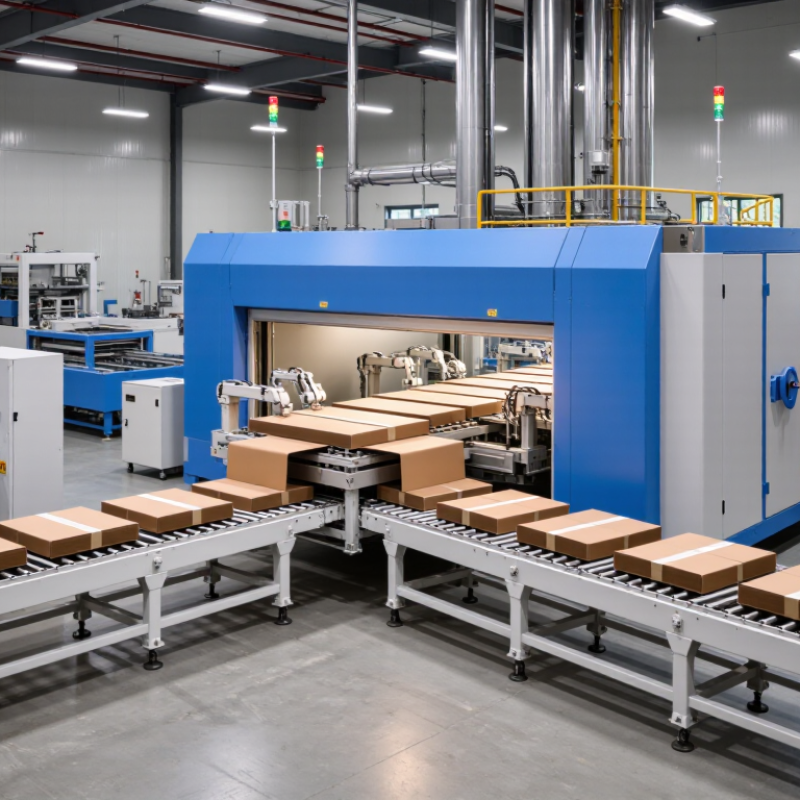
A box manufacturing machine converts paperboard into packaging through feeding, printing, cutting, creasing, folding, and joining. In a corrugated line, a corrugator bonds fluted paper between flat liners. Converting equipment then trims and shapes the board. Flexo folder-gluers commonly produce regular slotted cartons for shipping; rotary die-cutters make mailers, trays, and display boxes with custom outlines. Some lines also print logos or handling marks directly onto the board.
The scale is substantial. FEFCO’s 2022 European database reports about 47.9 billion square metres of corrugated board production. That figure describes regional output, not machine capacity, so it should not be used to predict one factory’s results. Not every box. A small workshop making short runs may need flexible changeovers more than top speed. A high-volume plant may prioritize automatic feeding and consistent folding. Board thickness, print detail, box dimensions, and setup time all affect the right configuration. “Best” is therefore a useful question, but not a fixed machine category. Even a fast line can disappoint when tooling changes are slow or operators lack training.
What Is the Best Box Manufacturing Machine in China? - What a Box Manufacturing Machine Does and Which Boxes It Produces
| Machine Type | What It Does | Typical Box or Board Output | Best Suited For | Key Selection Considerations |
|---|---|---|---|---|
| Corrugator line | Combines linerboard and fluted medium using heat, starch adhesive, and pressure to produce corrugated board. | Single-wall, double-wall, or other specified corrugated sheets, depending on the line configuration. | Factories producing corrugated board in-house for subsequent box converting. | Board grades, flute combinations, working width, production capacity, energy use, and required downstream equipment. |
| Flexo printer slotter folder-gluer | Prints, slots, scores, folds, and glues corrugated blanks in a connected production process. | Regular slotted cartons and many other printed, slotted corrugated shipping boxes. | High-volume production of standard shipping cartons with repeatable designs. | Print quality, number of print colors, blank-size range, changeover requirements, and the box styles the machine can process. |
| Rotary die-cutting machine | Uses a rotary die to cut and crease corrugated board into shaped blanks. | Die-cut corrugated boxes, trays, partitions, and display-style packaging blanks. | Boxes with nonstandard outlines, handles, windows, or features that are difficult to make by slotting alone. | Die design and cost, board compatibility, cutting accuracy, setup time, and expected order variety. |
| Flatbed die-cutting machine | Presses a flat cutting die against sheet material to cut and crease packaging blanks. | Custom corrugated or paperboard blanks, including cartons, trays, and specialty packaging. | Shorter runs, complex shapes, and work requiring precise die-cut features. | Sheet size, material thickness, tooling needs, feeding method, and the balance between setup time and run length. |
| Slitter-scorer | Slits corrugated board to width and makes score lines for folding. | Scored and sized corrugated sheets or blanks for further converting. | Simple box orders, sheet preparation, and operations where printing or die cutting is not required. | Number and flexibility of cutting and scoring heads, adjustment method, sheet size, and required accuracy. |
| Folder-gluer | Folds and joins pre-cut or pre-creased packaging blanks, commonly with adhesive. | Folded and glued corrugated boxes or paperboard cartons, depending on machine design. | Converting preprinted, pre-cut blanks into finished flat-packed boxes. | Compatible box styles, board thickness, glue application, folding accuracy, and integration with upstream equipment. |
| Digital cutting table | Uses computer-controlled cutting and creasing tools to make packaging prototypes or short-run blanks without a conventional cutting die. | Samples, prototypes, and small batches of corrugated or paperboard packaging. | Frequent design changes, product development, and low-volume custom orders. | Material and sheet-size limits, cutting speed, file workflow, crease quality, and suitability for the intended production volume. |
| Box stitching machine | Joins box flaps with staples instead of, or in some cases alongside, adhesive. | Stitched corrugated shipping cartons, commonly for applications requiring a mechanically fastened joint. | Heavy-duty or specified packaging jobs where stitching is suitable and permitted. | Staple type, joint strength requirements, box construction, operator safety, and customer or shipping specifications. |
| Automatic case erector | Forms flat corrugated blanks into open boxes and typically seals the bottom flaps. | Erected corrugated cases ready for filling and top closure. | Packaging lines that need consistent box forming at a repeatable rate. | Case-size range, blank quality, changeover time, line speed, and connection to filling and sealing equipment. |
How to choose: There is no single best machine for every box factory. Match the equipment to the box style, board or paperboard material, order volume, required print and cut quality, changeover frequency, and available floor space. A corrugator produces board; converting machines turn that board into box blanks or finished boxes.