A-B-C Blog
How to Choose Thermal Labelling for Global Buyers in 2026?
Choosing Thermal Labelling for global buyers in 2026 requires more than comparing prices per roll. Labels must survive transport, refrigeration, humidity, abrasion, and different scanning systems. A small adhesive failure can stop a pallet at a warehouse door. That risk is easy to underestimate.
Industry reports show why material selection matters. Smithers’ The Future of Global Labels and Packaging to 2028 identifies continued growth in pressure-sensitive and digitally printed labels, supported by e-commerce, logistics, and product traceability. FINAT’s European Label Industry Survey also indicates persistent cost pressure, volatile raw-material prices, and stronger sustainability expectations across the label supply chain. Meanwhile, AWA Alexander Watson Associates’ Global Release Liner Industry reports highlight the importance of liner performance, waste reduction, and converting efficiency. These findings point toward a practical conclusion: buyers should evaluate the complete labelling system, not only the face stock.
Start with the application.
For direct thermal labels, test image stability, heat sensitivity, and storage conditions. For thermal transfer labels, compare ribbon compatibility, print durability, and recycling constraints. Adhesive choice also requires real-world trials on corrugated cartons, plastic containers, glass, or frozen packaging. Global buyers should request technical data sheets, batch traceability, and sample validation from suppliers. Certifications can support credibility, but they do not replace testing.
The perfect label rarely exists.
A cheaper option may create higher replacement costs later. Buyers should review printer settings, carton surfaces, climate exposure, and local disposal practices before approving specifications. In 2026, the strongest purchasing decision will balance readability, reliability, compliance, total cost, and measurable environmental performance.
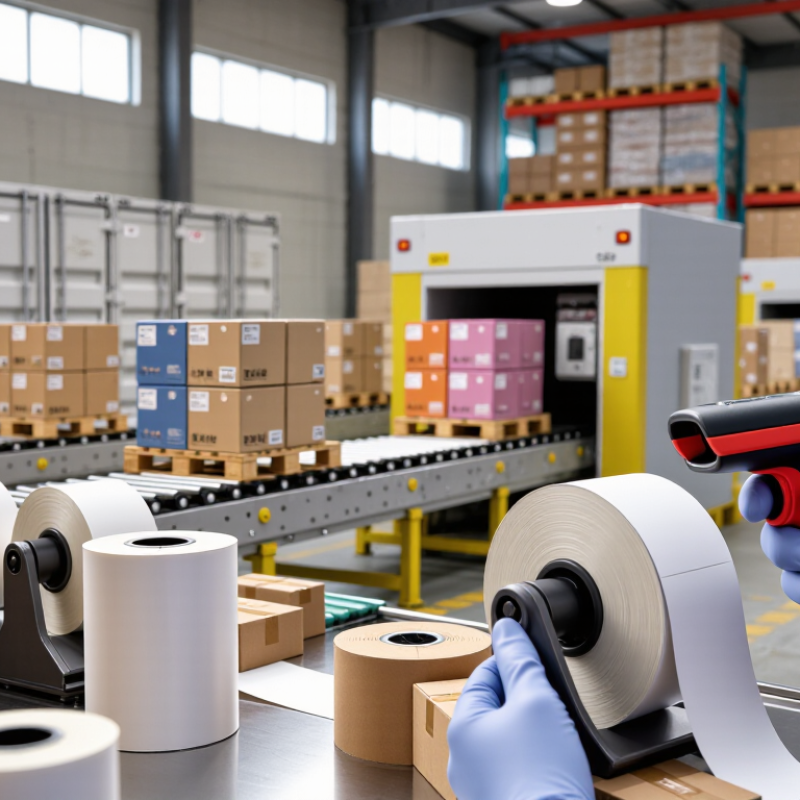
What Thermal Labelling Means in Global Supply Chains
Thermal labelling is more than printing text on adhesive stock. It is the physical data layer connecting products, warehouses, carriers, and customs teams. A label may carry a batch number, expiry date, destination, or handling instruction. If that information fades, the supply chain loses visibility quickly. Small details matter.
Global buyers usually choose between direct thermal and thermal transfer printing. Direct thermal labels suit short-term shipping and distribution needs. They can become unclear under heat, sunlight, or prolonged storage. Thermal transfer labels use a ribbon and often resist abrasion, moisture, and temperature changes better. This makes them useful for pallets, laboratory samples, cold-chain cartons, and long-distance inventory. Material selection must match the real environment, not just the printer specification.
I have seen label projects fail because teams tested printing indoors only. The label looked sharp, but condensation later weakened the adhesive. A practical evaluation should include transport vibration, freezer exposure, surface texture, and barcode scanning from different angles. Buyers should also confirm local data requirements, language needs, recycling rules, and supplier traceability. Standardized identifiers help different partners read the same information. Still, no label performs perfectly everywhere. A lower-cost option may be acceptable for a two-day shipment, but risky for months of outdoor storage. This trade-off deserves honest review before purchasing.
Which Thermal Label Types Fit Different Products and Environments
Choosing thermal labels for global buyers starts with the product and its working environment. Direct thermal labels suit short-term shipping, receipts, and indoor inventory. They print clearly without ribbons. However, heat, sunlight, and plasticizer exposure can darken them over time. Thermal transfer labels provide stronger durability for asset tags, cartons, and outdoor containers. Their resin or wax-based ribbons can resist abrasion, moisture, and handling. Paper labels remain economical for clean, dry surfaces. Synthetic films perform better on curved, damp, or frequently touched products.
Tips: Match the label to its surface, temperature, and expected lifespan. Test adhesion after refrigeration, condensation, rubbing, and repeated handling. A label may pass a desk test and fail in a warehouse.
For frozen products, select an adhesive designed for low temperatures. Standard adhesives may peel when cartons become cold or wet. For dusty packaging, a stronger adhesive can help, but excessive strength may damage delicate surfaces. Small labels also need careful contrast and barcode sizing. Scanners may struggle when printing is too small or uneven. Global shipments often face changing climates, so testing only in one location is risky. The label material, adhesive, printer settings, and storage conditions must work together. No choice is perfect. A cheaper label can become expensive after relabelling, returns, or lost traceability. Before large-scale purchasing, compare samples under realistic conditions and document the results. Even experienced teams sometimes overlook condensation. That detail deserves attention.
How to Choose Thermal Labelling for Global Buyers in 2026?
Which Thermal Label Types Fit Different Products and Environments
Representative continuous-use temperature ranges show why direct thermal paper is commonly selected for short-life logistics labels, while synthetic facestocks and thermal-transfer printing are better suited to moisture, abrasion, outdoor exposure, cold-chain handling, and longer service periods. Actual performance depends on the adhesive, facestock, ribbon, printer settings, and exposure conditions.
How to Compare Materials, Adhesives, and Printing Technologies
How to Choose Thermal Labelling for Global Buyers in 2026?
Choosing thermal labels in 2026 requires more than comparing prices. The label must survive the journey, storage conditions, and final handling environment. In practical evaluations, I check the surface, temperature range, moisture exposure, and expected label life. A cold warehouse can expose adhesive weaknesses within hours. Small details matter.
Direct thermal material suits short-term shipping, receipts, and labels without ribbon printing. It is simple and cost-efficient, but heat and sunlight can darken the image. Thermal transfer material usually offers stronger resistance to abrasion, chemicals, and outdoor exposure. It needs a compatible ribbon, and that adds operating cost. Neither option wins every application.
Adhesive selection deserves equal attention. Permanent adhesive works well on clean cartons, while removable adhesive helps protect reusable containers. Freezer applications need formulas designed for cold surfaces, not ordinary general-purpose glue. Testing is essential. Apply samples to the actual packaging, then expose them to condensation, friction, and temperature changes. I have seen labels pass a dry-room test and fail after overnight refrigeration. That result is easy to miss.
Printing technology also affects reliability. Match the printer, ribbon, speed, and resolution before placing a large order. Ask suppliers for material specifications, aging data, and batch consistency records. Regional climate differences can change results. A label designed for a dry warehouse may struggle during humid ocean transport. The perfect specification rarely exists; careful testing usually reveals the most practical compromise.
How to Choose Thermal Labelling for Global Buyers in 2026? - How to Compare Materials, Adhesives, and Printing Technologies
| Comparison Dimension | Direct Thermal Paper | Thermal Transfer Paper | Thermal Transfer Film | Buyer Guidance for 2026 |
|---|---|---|---|---|
| How the image is created | Heat-sensitive coating darkens when activated by the printhead; no ribbon is required. | A heated printhead transfers ink from a ribbon onto a paper face stock. | A heated printhead transfers ink from a ribbon onto a synthetic film face stock. | Select the process according to expected label life, exposure conditions, and required resistance—not only initial label cost. |
| Typical service life | Short-term identification, commonly used for days to several months depending on coating, light, heat, and handling. | Suitable for longer-term paper labels when protected from severe moisture and abrasion. | Suitable for durable labels that may remain readable for months or years when the correct ribbon and construction are used. | Define the required readable period in writing and validate it under actual storage and transport conditions. |
| Resistance to sunlight and UV | Limited; direct sunlight and ultraviolet exposure can cause image fading or darkening. | Generally better than direct thermal when a suitable ribbon is used, but paper may still degrade outdoors. | Generally strong, especially with a suitable resin or resin-enhanced ribbon and UV-resistant face stock. | For outdoor or window-exposed applications, test printed labels after UV and temperature aging. |
| Moisture and condensation | Standard paper grades are vulnerable to water, condensation, and humidity; water-resistant grades offer improved protection. | Paper remains moisture-sensitive, although the transferred image can be more resistant than the face stock. | Synthetic films are generally more resistant to water and condensation than paper. | For chilled, frozen, or wet environments, evaluate both face stock and adhesive after condensation cycles. |
| Abrasion and chemical resistance | Low to moderate unless protected by a coating or laminate. | Moderate to high depending on ribbon formulation, print density, and protective coating. | High potential with an appropriate resin-based ribbon and compatible film. | Use an immersion, rub, and chemical-wipe test based on the actual cleaning agents and handling process. |
| Common face-stock materials | Thermal-coated paper; top-coated grades improve print quality and environmental stability. | Uncoated, coated, semi-gloss, or high-gloss paper designed for ribbon transfer. | Polypropylene, polyethylene, polyester, or other synthetic films selected for flexibility, clarity, or durability. | Match the face stock to temperature range, surface energy, flexing, recycling requirements, and disposal conditions. |
| Print sharpness and barcode quality | Good for standard text and barcodes when the coating and printhead are well matched; image can degrade with age or heat. | Good to excellent; coated paper and a compatible ribbon can produce sharp small text and barcodes. | Good to excellent; stable film surfaces support high-quality barcodes when print settings are optimized. | Verify barcode quality using the applicable ISO/IEC 15415 or ISO/IEC 15416 grading method. |
| Required consumables | Labels only; no ribbon is needed. | Labels plus thermal transfer ribbon. | Labels plus thermal transfer ribbon, often selected by required resistance and surface compatibility. | Include ribbon consumption, storage, disposal, and printer maintenance in total-cost calculations. |
| Low-temperature performance | Special cold-temperature grades may be required; standard adhesives can lose tack or become brittle. | Cold-temperature grades improve performance, but paper and adhesive selection remain critical. | Film remains dimensionally stable, but the adhesive must be rated for application and service temperatures. | Test application at the coldest surface temperature, not only at room temperature. |
| Adhesive options | Permanent, removable, freezer-grade, and hot-melt constructions are available. | Permanent or removable adhesives can be specified according to the substrate and label life. | Permanent, removable, repositionable, high-tack, and specialty adhesives are commonly used. | Specify substrate, application temperature, service temperature, dwell time, and removal requirements. |
| Adhesion to difficult surfaces | May require a stronger adhesive for corrugated cartons, textured surfaces, dusty packaging, or cold goods. | Paper construction is effective on many cartons and smooth packaging but may need specialty adhesive on plastics. | Often preferred for smooth plastics, curved containers, and durable packaging when paired with the correct adhesive. | Measure initial tack and peel adhesion on the exact packaging material after realistic aging. |
| Removability and residue | Removable grades can support temporary identification, but residue and tearing depend on surface and dwell time. | Removable paper labels are suitable for some short-term applications; moisture can affect removal behavior. | Film labels can remove cleanly when designed for removability, but strong adhesives may leave residue or damage surfaces. | Define acceptable residue, removal speed, and surface condition before approving a removable construction. |
| Print speed and operational fit | Efficient for high-volume, variable-data printing because ribbon handling is not required. | Supports high-volume variable-data printing, with ribbon replacement and setup included in workflow planning. | Supports durable variable-data printing; print speed depends on film, ribbon, darkness, and printer capability. | Compare actual throughput, changeover time, reject rate, and maintenance—not printer speed alone. |
| Indicative cost position | Usually the lowest consumable cost when short life and limited resistance are acceptable. | Moderate; total cost includes paper labels and ribbons. | Usually higher than paper because of synthetic face stock and specialty ribbons, but may reduce replacement and reprint costs. | Calculate total cost of ownership using label, ribbon, labor, waste, reprints, and failure-related costs. |
| Sustainability considerations | Paper-based, but thermal coatings, liners, adhesives, and recycling rules must be reviewed. | Paper-based, but the ribbon and adhesive may affect recycling and waste handling. | Synthetic films can complicate recycling; construction should be assessed with the packaging system. | Request material declarations, recycled-content information, liner details, and end-of-life guidance for each market. |
| Regulatory and market checks | Food-contact suitability, chemical restrictions, and thermal-coating declarations may be relevant. | Paper, adhesive, ribbon, and ink-transfer components may require separate documentation. | Film, adhesive, ribbon, and intended-use declarations should be checked for the destination market. | Review destination-country rules, food-contact requirements, chemical regulations, and transport-label standards before production. |
| Best-fit applications | Shipping labels, receipts, short-term logistics labels, weighing labels, and temporary inventory identification. | Carton labels, product identification, warehouse labels, and applications needing improved image durability on paper. | Outdoor assets, chemical or abrasion exposure, reusable containers, medical or laboratory identification, and long-life product labels. | Choose the simplest construction that passes the complete performance and compliance test plan. |
What Global Buyers Should Check for Compliance and Compatibility
How to Choose Thermal Labelling for Global Buyers in 2026?
Global buyers should treat thermal labels as compliance components, not simple packaging supplies. Check the destination market’s labelling rules before approving artwork or materials. Requirements may cover language, symbols, recycling information, product identification, and traceability data. Ask suppliers for material specifications, adhesive test results, and declarations covering restricted substances. Keep these records with purchase documents. They can support audits and reduce costly rework.
Compatibility deserves equal attention. Confirm the printer’s core size, roll width, winding direction, sensor position, and print method. Direct thermal labels suit short-term use but may darken under heat, sunlight, or friction. Thermal-transfer labels usually require a compatible ribbon and careful calibration. Test adhesion on the actual carton, plastic, glass, or coated surface. Cold storage changes performance. Dust does too. Fit matters.
A barcode must remain readable after transport, condensation, and handling. Scan samples at different distances and angles. Request tests from an independent laboratory when risk is high. Supplier claims help, but they are not enough. A small adhesive failure can stop a shipment. A minor artwork change can create a compliance issue. Buyers should also confirm whether local disposal systems accept the label and liner materials. This point is often overlooked, and requirements may change during a product’s sales period. Build a review date into the purchasing process, even when the first approval looks perfect.
How to Evaluate Costs, Suppliers, and Long-Term Performance
How to Choose Thermal Labelling for Global Buyers in 2026?
Thermal labelling costs begin with more than the roll price. Compare labels by usable metres, print speed, waste, and replacement frequency. A low-cost roll may contain less material. It may not be cheaper. Calculate the total cost per readable label, including rejected prints and machine cleaning.
Ask suppliers for production samples, not only specification sheets. Test the same artwork on your printers, scanners, and applicators. Check barcode contrast, adhesive strength, edge lifting, and liner release. Store samples in heat, humidity, cold rooms, and direct warehouse light. Small differences become visible after several weeks. Request batch records, material details, quality controls, and realistic lead times. A reliable supplier should explain variation instead of hiding behind broad tolerances.
Long-term performance needs practical evidence. Run a pilot across different sites and transport conditions. Measure print clarity after rubbing, stacking, condensation, and repeated handling. Confirm whether the supplier can maintain core sizes, roll winding, packaging, and delivery schedules. Keep a qualified backup source when continuity matters. Still, dual sourcing can increase inspection work and create colour or adhesive differences. That trade-off deserves honest review. I would also question forecasts that assume perfect storage, because warehouses rarely behave perfectly. A label that performs well in a clean test room may fail beside a cold loading dock.