What is Food Checkweighing Machinery and How Does It Work?
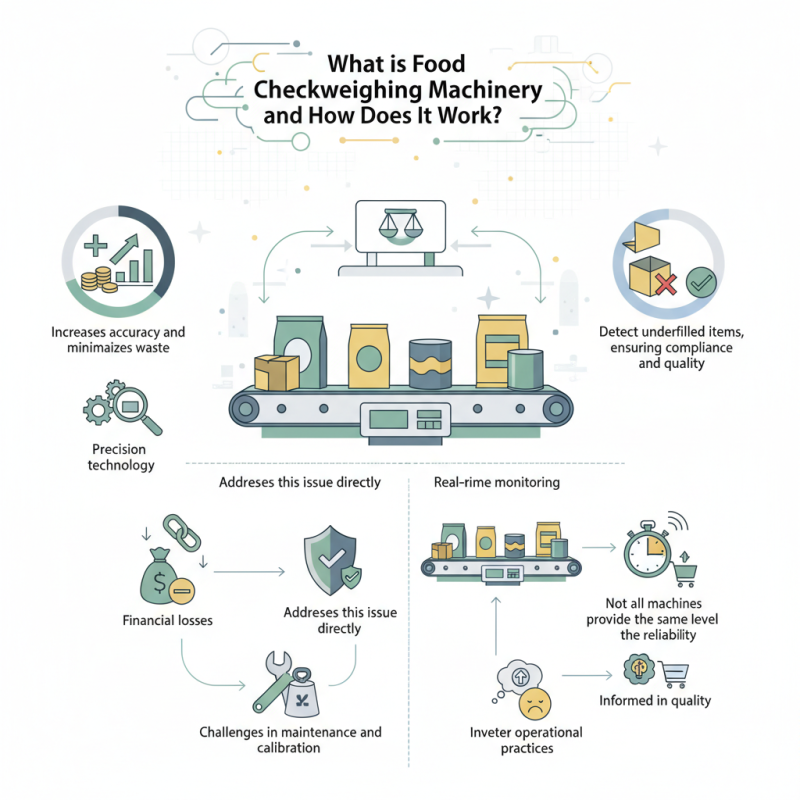
Food Checkweighing Machinery is a critical component in the food industry. It ensures that products meet weight specifications. This equipment increases accuracy and minimizes waste. By using precision technology, businesses improve their operations effectively. The machinery can detect underfilled items, ensuring compliance and quality.
Many companies struggle with weight discrepancies, leading to financial losses. Food Checkweighing Machinery addresses this issue directly. It integrates seamlessly into production lines for real-time monitoring. This means that manufacturers can quickly identify problems. However, not all machines provide the same level of reliability. Understanding their capabilities is essential for making informed choices.
Investing in quality checkweighers elevates production standards. Nonetheless, selecting the right model requires careful consideration. Businesses often face challenges in maintenance and calibration. These factors can influence the overall performance of the equipment. Awareness of these issues can lead to better operational practices.
What is Food Checkweighing Machinery? An Overview of Its Purpose
Food checkweighing machinery is crucial in ensuring product integrity in the food industry. This type of machinery measures the weight of packaged goods, helping companies maintain compliance with regulatory standards. According to recent industry reports, around 25% of consumers cite accurate product weight as a top concern when purchasing food items.
The machinery typically operates by using high-precision load cells. These sensors detect minute changes in weight, enabling accurate measurements at high speeds. In fact, automated checkweighers can assess weights within a tolerance of ±0.5 grams. This precision minimizes the chances of underfilling or overfilling products, which can lead to financial losses and diminish customer trust.
Furthermore, the implementation of checkweighing systems can significantly reduce product recalls. A study showed that companies using these systems reported a 30% decrease in recall incidents related to weight discrepancies. However, not all setups are flawless. Improper calibration or environmental factors like vibrations can lead to errors. Regular maintenance and staff training remain essential to address these challenges effectively.
What is Food Checkweighing Machinery and How Does It Work?
| Feature | Description | Importance |
| Precision | Ensures accurate measurements of food products. | Reduces waste and maintains product consistency. |
| Speed | Capable of checking large quantities quickly. | Increases production efficiency and throughput. |
| Compliance | Helps meet regulatory standards for weight measurements. | Avoids penalties and ensures product reliability. |
| User-Friendly Interface | Easy to operate and integrate with existing systems. | Reduces training time and improves operational efficiency. |
| Data Logging | Records weight data for traceability and analysis. | Enhances quality control and inventory management. |
The Role of Accuracy in Food Checkweighing: Industry Standards and Metrics
Accuracy in food checkweighing is crucial. In the food industry, it ensures products meet regulatory standards. If a product is underweight, it can lead to customer complaints. Overweight items lead to financial losses due to excessive material costs.
Industry standards dictate the acceptable weight tolerance. Each sector has specific requirements. A bakery may have a different threshold than a meat processing unit. Compliance with these standards ensures quality and customer trust. Inaccurate measurements distort the fairness of product pricing.
Checkweighing machinery employs advanced technology. It uses load cells and software to ensure precision. However, even small errors can occur. Regular calibration and maintenance are essential. Operators need training to minimize human error. Continuous assessment of processes can improve reliability, though challenges remain in achieving perfect accuracy.
Food Checkweighing Machinery Accuracy Metrics
How Food Checkweighing Machinery Operates: Key Components Explained
Food checkweighing machinery plays a crucial role in ensuring product accuracy and quality in the food industry. These machines are designed to weigh products as they move along a production line. With precision weighing capabilities, they help comply with regulatory standards.
Key components of food checkweighing machinery include the load cell, conveyor belt, and display unit. The load cell detects the weight of the product with great accuracy. It converts this weight into an electrical signal. This signal is then processed and displayed for operators. Conveyors transport the products seamlessly through the weighing station, allowing for efficient workflow.
While these machines are reliable, some issues can arise. Calibration must be checked regularly to maintain accuracy. Environmental factors, like temperature or humidity, can also affect performance. Operators must remain vigilant and address any discrepancies swiftly. Consistent monitoring of the machinery ensures optimal functioning and product integrity.
The Benefits of Using Food Checkweighing Machinery in Manufacturing
Food checkweighing machinery plays a crucial role in the manufacturing process. It ensures that products meet specific weight requirements during production. With the rise of consumer demands, precision has become vital. Accurate weight measurements help prevent underfilling and overfilling, protecting both the consumer and manufacturer. This equipment also saves time by automating the checking process.
The benefits of using food checkweighing machinery are numerous. Efficiency is significantly improved. Automated systems reduce human error, leading to greater consistency in product quality. These machines can quickly assess multiple packages, enhancing productivity. Furthermore, compliance with regulations is simplified. Companies can easily document weights for quality assurance.
However, implementing such systems isn’t without challenges. Some manufacturers face initial costs and training requirements. Additionally, maintenance is essential to prevent malfunctions. Regular checks can ensure accuracy over time. Ultimately, balancing the benefits with these challenges is key to leveraging this technology effectively.
Trends and Innovations in Food Checkweighing Technology and Equipment
In the rapidly evolving world of food processing, checkweighing technology has seen significant advancements. This machinery plays a crucial role in ensuring product weight accuracy. Companies are increasingly adopting highly sensitive scales. These scales not only meet regulatory standards but also enhance consumer trust. Accurate measurements help avoid product waste, which is a growing concern.
Recent trends focus on automation and integration. Smart checkweighers are now equipped with AI capabilities. This allows for real-time data analysis, significantly improving efficiency. Moreover, the trend toward sustainability pushes companies to minimize packaging materials. Some machines are designed to accommodate eco-friendly practices. However, the implementation of these technologies may pose challenges. Integration into existing systems often requires a thoughtful approach.
Another area of innovation is the user interface. Modern machines offer touchscreen controls and intuitive software. This makes operation simpler for workers, reducing errors during checks. However, user training remains essential to maximize efficiency. The balance between automation and human oversight is still a topic for discussion. Overall, the evolution of checkweighing technology reflects a keen focus on accuracy and sustainability while acknowledging the need for continuous improvement.


