
A-B-C Blog

Why Use Potassium Humate for Plants?

Potassium Humate is often presented as a simple fix for tired soil. It is not. This potassium salt of humic substances can support nutrient availability, soil structure, and root-zone activity, but results depend on the product, soil, crop, and application rate. A dark, crumbly garden bed and a compacted field do not respond in the same way.

Soil scientist Dr. Robert L. Pettit’s work on humic substances offers a useful caution. In paraphrase: “Judge a soil amendment by measured soil and crop responses, not broad promises.” That is a practical standard, not a guarantee. Growers can compare treated and untreated plots, record application rates, and watch for changes in root growth, water infiltration, or nutrient status. Small differences matter. So do disappointing results.

This guide explains why growers use Potassium Humate, what it may contribute, and where expectations should stay modest. The product is not a complete fertilizer, and it cannot replace sound soil testing or crop management. Quality also varies; labels and soluble-content details deserve a close look. A teaspoon in a watering can may be convenient for a small garden, while field use requires careful rate calculations. Start with evidence. Adjust cautiously. The soil may still surprise you.
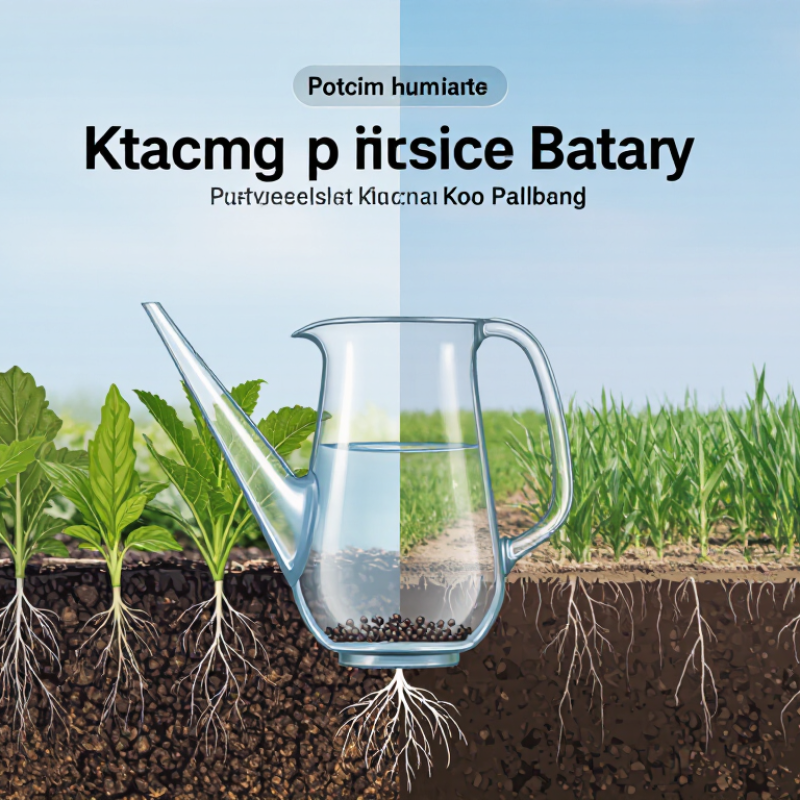
Why Use Potassium Humate for Plants?

What Potassium Humate Is: A Soluble Potassium Salt of Humic Substances

Potassium humate is a water-soluble potassium salt of humic substances, not one pure chemical. Humic substances are complex organic fractions formed as plant and animal material decomposes. In alkaline extraction, humic acids react with potassium, producing a form that can dissolve in irrigation water. The liquid may look dark brown, like strong tea. Its composition varies with the source material and processing.

That variation matters. Potassium humate supplies potassium, while its humic fractions may influence nutrient availability and root growth. A 2014 meta-analysis by Rose and colleagues in Frontiers in Plant Science reported average increases of about 22% in shoot dry weight and 21% in root dry weight across studies of humic substances. Those figures are not a guaranteed response to potassium humate in every field. Crop, soil, dose, and application method all matter. Not a miracle. A grower should check the product’s solubility, potassium content, and pH, then compare treated rows with untreated ones. Some mixtures can leave sediment or perform poorly in hard water, so a small jar test is practical before running a full irrigation line.

How Humic Compounds Influence Soil Structure and Nutrient Retention

Potassium humate adds humic compounds to the root zone, where they interact with clay and organic particles. These materials can help small particles form stable aggregates. Better aggregation may create pores for air and water, while reducing surface crusting after irrigation. The change is gradual. It depends on soil texture, pH, and application rate.

Nutrient retention is another reason growers use it. Humic compounds carry negatively charged sites that can hold positively charged nutrients, including potassium, calcium, and magnesium. This may make nutrients less prone to leaching, though it does not replace balanced fertilization. In a 2014 meta-analysis in Frontiers in Plant Science, Rose and colleagues reported average increases of 22% in shoot dry weight and 21% in root dry weight across the studies reviewed. Those results covered different humic substances and growing conditions, not potassium humate alone.

Field results are less tidy. In sandy soil, a modest dose may support nutrient retention, while compacted clay needs physical and biological improvement too. Not a quick fix. A jar test or small plot can help assess compatibility and response before wider use. The soil decides. Evidence supports potential benefits, but effects vary, and the mechanisms are not fully predictable in every field.

How Potassium Humate May Support Root Growth and Nutrient Uptake

Why Use Potassium Humate for Plants?

How Potassium Humate May Support Root Growth and Nutrient Uptake

Potassium humate supplies potassium and humic compounds that may influence root development and nutrient availability. In soil, humic substances can interact with mineral nutrients and support conditions around roots. That may help plants access nutrients, but results depend on soil, crop, dose, and product quality. It is not a substitute for balanced fertilization.

A peer-reviewed meta-analysis by Rose and colleagues, published in Advances in Agronomy in 2014, reported average increases of 21% in root dry mass and 22% in shoot dry mass after humic-substance treatments. Responses varied widely across studies. The finding is useful context, not a guarantee for potassium humate in every field. A larger root system may explore more soil, yet nutrient uptake also depends on moisture, pH, and existing fertility.

Tips: Apply according to the label and soil-test results. Compare a treated strip with an untreated one, then inspect fine roots and new growth. Keep notes. One season may not tell the whole story. Avoid assuming more product means better results; excess potassium can disturb nutrient balance.

Why Crop and Soil Conditions Shape Field Responses to Humic Products

Why Use Potassium Humate for Plants?
Why Crop and Soil Conditions Shape Field Responses to Humic Products

Potassium humate can support soil management, but its field effect depends on where and how it is used. It is not a complete fertilizer, and it cannot correct every nutrient shortage. Sandy soil with low organic matter may respond differently from heavy clay that already holds water and nutrients. Soil pH, salinity, drainage, and existing fertility all matter. A product that works well in one field may show little change in another.

Crop type and growth stage also shape the response. Young roots, established crops, and drought-stressed plants do not take up water and nutrients in the same way. Application rate and irrigation affect contact with the root zone, too. A common mistake is judging results from leaf color alone. Compare treated and untreated strips, and record soil conditions and crop stage. Responses can still be uneven; that uncertainty deserves attention, not a stronger claim.

Tips: Check soil-test results before application. Follow the product label, keep other fertilizer practices consistent, and look for changes in root growth, water infiltration, and yield across more than one season.

Why Use Potassium Humate for Plants? - Why Crop and Soil Conditions Shape Field Responses to Humic Products

Crop or soil condition Potential role of potassium humate Why the response may vary Practical field consideration
Coarse-textured soil with low organic matter Humic substances may support soil aggregation and nutrient-use processes; a response is more plausible where organic matter and nutrient management are limiting. Humic products do not replace the broader benefits of adding organic matter, and results depend on soil properties, product composition, rate, and crop. Use soil testing and sound fertilizer management. Treat potassium humate as a possible supplement, not as a substitute for compost or other organic-matter inputs.
Calcareous or high-pH soil Humic substances can interact with micronutrients and may affect their availability near roots. High pH and calcium carbonate can limit the availability of nutrients such as iron. A humic product may not correct a severe deficiency or change whole-field soil pH. Confirm the deficiency with soil or plant analysis and select a nutrient treatment suited to the crop and soil. Do not assume potassium humate alone will resolve iron chlorosis.
Soil with adequate fertility and organic matter Additional humic material may have little visible effect when crop growth is not limited by a correctable factor. Responses tend to be harder to detect when nutrients, water, rooting conditions, and crop management are already adequate. Compare treated and untreated areas under the same management before adopting a product across a large field.
Saline or sodic soil Humic substances may influence soil structure or nutrient interactions, but they are not a dependable stand-alone remedy for excess salts or sodicity. Salt injury and sodic soil structure require diagnosis and management matched to the specific problem; potassium humate does not remove salts from the root zone. Measure soil salinity and, where relevant, sodicity. Base reclamation on drainage, water quality, and appropriate amendments recommended for the soil.
Crop experiencing drought or heat stress Some studies report changes in root growth or stress-related crop responses, but effects are not consistent across crops and conditions. Water availability, stress timing, crop stage, and application method strongly influence outcomes. A humic product cannot replace irrigation or reduce the weather stress itself. Prioritize water and soil-moisture management. Evaluate any humate treatment locally rather than assuming a universal stress-protection effect.
Low potassium status Potassium humate supplies potassium only to the extent indicated by the product’s guaranteed analysis; the humic fraction may have separate soil or plant interactions. Potassium content varies among formulations, so the product may not provide enough potassium to meet crop demand. Check the label and calculate the actual potassium contribution. Use a crop-appropriate potassium fertilizer program based on soil testing and yield goals.
Different crops, growth stages, or application methods Root-zone applications and foliar applications expose plants and soil to the product in different ways, so their results should not be assumed to be interchangeable. Crop species, rooting pattern, growth stage, formulation, rate, and compatibility with other inputs can change the outcome. Follow the product label, check tank compatibility where relevant, and assess crop response using replicated or side-by-side field comparisons.

Interpretation: Potassium humate is a source of humic substances and, depending on its formulation, potassium. Field responses are variable and are most meaningfully evaluated in the context of crop needs, soil conditions, product composition, and standard nutrient management.

How to Check Product Quality: NY 1106-2010 Specifies ≥30% Humic Acid and ≥8% K₂O

When buying potassium humate, check the guaranteed analysis before comparing price or color. Under NY 1106-2010, the specified product should contain at least 30% humic acid and 8% K₂O. These figures give you a measurable starting point. They do not, by themselves, prove that a product will suit every crop or soil.

Read the label carefully. Confirm that the analysis is reported on the same basis as the standard, and ask for a recent test certificate tied to the production batch. A certificate is more useful when it names the test methods and laboratory. If the result is close to either minimum, consider independent testing. Sampling matters; a single scoop from a poorly mixed bag can mislead. Look for clear instructions on dilution and application, too. In practice, I would test a small area first and watch for changes in leaf color or soil response. Not instant magic. Humic substances and potassium may support nutrient management, but they cannot replace a balanced fertilizer plan or correct every growing problem. Be cautious of vague claims that promise dramatic results without data.

How to read this chart: The bars show the minimum content thresholds stated in NY 1106-2010: at least 30% humic acid and at least 8% K₂O. These are specification limits, not test results for a particular product.