


10 Best Robotic Palletizers for Global Buyers
Choosing among the 10 Best Robotic Palletizers for Global Buyers means looking beyond advertised speed. A Robotic Palletizer must handle your actual cartons, bags, or cases—not just a demonstration load. Watch how it places a full layer, changes formats, and recovers after a product jam. Small details matter. A gripper that slips on dusty packaging can disrupt an entire shift.
Joseph F. Engelberger, a pioneer of industrial robotics, is often quoted as saying, “I can’t define a robot, but I know one when I see one.” For buyers, the practical test is less poetic: Can the system meet your throughput, footprint, and maintenance needs? Compare payload, reach, controls, safety features, and the availability of local service. Ask suppliers for references from facilities handling similar products. Check what happens when a carton changes size or a sensor needs adjustment. Not every line fits.
This guide compares ten options for different operating conditions and investment priorities. Some systems may offer impressive speed but require more floor space or integration work. Others may suit mixed products better, yet need careful testing before purchase. Specifications alone rarely tell the whole story. Treat them as a starting point, then verify performance with your own loads and pallet patterns. There is no perfect machine for every plant. That is worth admitting before choosing one.
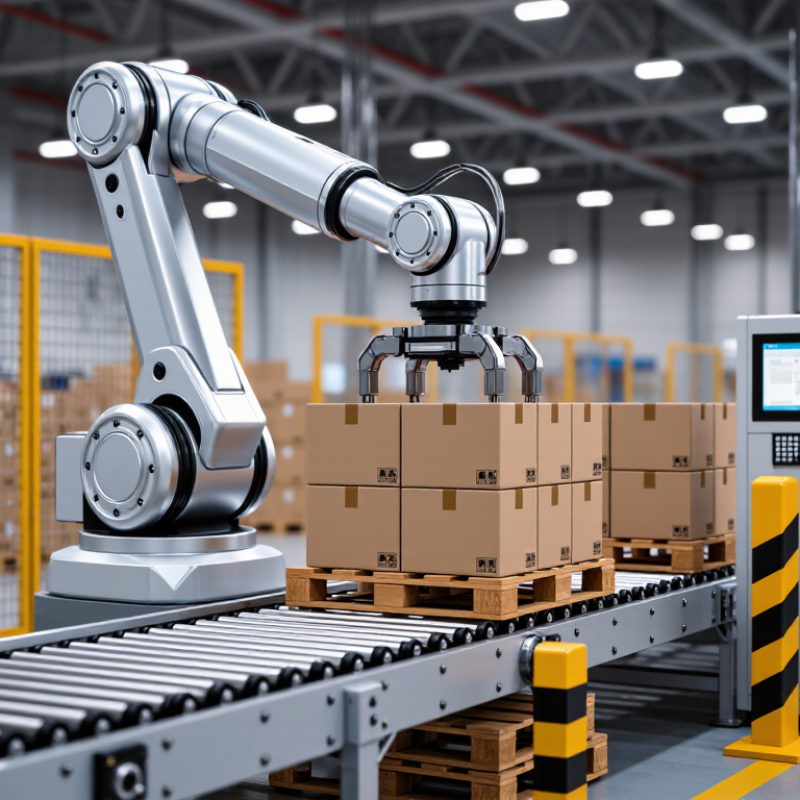
Global Robotics Context: IFR Recorded 541,302 Industrial Robot Installations in 2023
The International Federation of Robotics (IFR) recorded 541,302 industrial robot installations worldwide in 2023, according to its World Robotics 2024 report. That was 2% below the 2022 record, but still the second-highest annual total reported. The global operating stock reached about 4.28 million units, up 10%. The market is large, yet uneven: Asia accounted for roughly 70% of new installations, with Europe at 17% and the Americas at 10%.
This growth gives palletizing automation a strong industrial context, but the headline figure needs care. It counts industrial robots across many tasks, not palletizers alone. A robot stacking cartons at the end of a line must match the product’s weight, box dimensions, cycle rate, and available floor space. Small details matter. Slippery packaging, shifting case sizes, or a narrow aisle can disrupt a layout that looked efficient on paper. IFR’s figures show broad adoption, not a guarantee of quick returns for every facility.
For global buyers comparing robotic palletizers, look beyond installation totals. Check payload and reach against actual pallet patterns, then assess guarding, operator access, and integration with conveyors. Ask for a cycle-rate test using real cartons, including the heaviest and least stable loads. The IFR report is a useful market benchmark, while site trials and maintenance plans provide evidence about local performance. One gap remains: public installation data rarely identifies palletizing as a separate application, so buyers should avoid treating overall robot growth as a direct measure of palletizer demand.
10 Best Robotic Palletizers for Global Buyers - Global Robotics Context: IFR Recorded 541,302 Industrial Robot Installations in 2023
The International Federation of Robotics (IFR) reported 541,302 industrial robot installations worldwide in 2023. The options below are application profiles—not a brand ranking. Actual throughput, payload, reach, and pallet patterns depend on the selected equipment and end-of-arm tooling.
| Robotic Palletizer Profile | Best-Fit Application | Load and Product Considerations | Layout Considerations | Key Selection Check |
|---|---|---|---|---|
| Six-axis articulated robot | Mixed-product palletizing and changing pallet patterns | Useful where the robot must approach products from different angles; payload must account for the gripper and product together. | Needs a suitable robot working envelope and safe access around the cell. | Confirm reach, combined payload, cycle time, and the number of pallet positions. |
| Collaborative robot palletizer | Lower-throughput lines, flexible production areas, and frequent changeovers | Can handle suitable cases or packages when the payload and application meet system limits. | May support a compact, reconfigurable setup; collaborative operation still requires a task-specific risk assessment. | Check required throughput, tool weight, safety requirements, and pallet height. |
| High-payload articulated palletizer | Heavy bags, cases, or bundled products | Designed for heavier combined loads; the gripper’s mass reduces the payload available for the product. | Requires a layout and guarding plan suited to the robot’s reach and operating area. | Verify maximum product weight, gripper weight, acceleration, and duty cycle. |
| Gantry-style robotic palletizer | Large or regular palletizing zones and multi-position layouts | Overhead axes can serve defined pick-and-place areas; product and tooling loads must stay within system limits. | Requires overhead structure and clearance, which should be checked against the building layout. | Assess available headroom, travel distances, pallet positions, and maintenance access. |
| Layer-forming robotic palletizer | Products that can be arranged into stable layers before placement | Suitable for applications where layer formation and load stability are central to the pallet pattern. | May need product accumulation or layer-forming equipment upstream. | Validate layer pattern, product orientation, slip-sheet needs, and pallet stability. |
| Bag palletizing cell | Filled bags of products such as grain, feed, or building materials | Bag shape and surface friction can vary; bag flattening or alignment may be needed for stable stacking. | Allow space for bag handling, orientation, and pallet discharge equipment. | Test representative bags and confirm acceptable stack stability and pattern. |
| Case and carton palletizing cell | Food, beverage, consumer goods, and general packaging lines | Works with suitable cartons when dimensions, weight, and case strength are consistent with the gripper design. | Plan for case infeed, pallet exchange, and access to finished loads. | Check carton strength, case-size range, orientation, and required pallet pattern. |
| Mixed-SKU palletizing system | Distribution and order-fulfillment operations with varied case sizes | Requires reliable product identification and software that can build the required mixed-load pattern. | May require buffering, scanning, and coordinated case sequencing upstream. | Confirm SKU range, data integration, pattern rules, and mixed-load stability. |
| Dual-pallet-position system | Lines that need pallet exchange while production continues | Handles the same product considerations as its selected robot and gripper configuration. | Uses more floor space than a single-position layout but can support pallet changeover without stopping every placement cycle. | Compare changeover needs, available floor area, and line-buffer capacity. |
| Robotic palletizing cell with automatic pallet handling | Facilities seeking coordinated pallet supply and finished-pallet removal | Product handling depends on the robot and end-of-arm tooling selected for the application. | Integrates pallet dispensing or conveying, so the full cell footprint and traffic flow must be planned. | Check pallet types, infeed and outfeed routes, guarding, and downstream interface requirements. |
Selection note: “Best fit” describes a common application match, not a performance guarantee. Compare suppliers using the same product samples, pallet patterns, operating hours, safety requirements, and acceptance-test criteria.
Related Posts
-
What Is Palletizing Equipment?
-
What Is a Palletizer Machine and How Does It Work?
-
Why Choose a Palletizer Machine for Your Business?
-

Essential Checklist for Maximizing Efficiency with Your Box Taping Machine
-
Why Are Containers and Packaging Important?
-

Navigating Trends and Innovations in Package Machine Industry at 2025 China Import and Export Fair